Many people enjoy working from home. You have no commute. You have the comfort of your kitchen and bathroom. You have quiet. It’s a great setup.
Until you see how it looks from the outside.
Working from home does offer flexibility and savings. But it also offers problems. Like the moment a potential client Googles your business and finds a residential address in a neighborhood they don’t recognize, or the moment you realize you have nowhere professional to meet someone face to face, or the moment your home address ends up on a contract, a business license, or a public-facing directory you can’t easily undo.
For a lot of freelancers, consultants, and small business owners in the Thousand Oaks area, a virtual office address is the piece that makes everything else work — the professional infrastructure that a home office simply can’t provide on its own. It’s not about pretending to be something you’re not. It’s about presenting your business the way it deserves to be presented.
A business address does more than tell people where to send mail.
It signals legitimacy.
A suite number on a professional street in a recognized business district communicates something about your operation before anyone has spoken with you. A home address communicates something too — and for many clients, particularly in professional services, financial services, legal work, consulting, or any field where trust is built before a contract is signed, it creates hesitation that is difficult to overcome later.
There’s a particular dynamic that plays out when a potential client is deciding between two service providers who seem comparable on paper. One has a business address in a professional office building. The other has a residential address. The decision often goes to the first one — not because their work is better, but because the presentation inspires more confidence. That’s a real competitive disadvantage that has nothing to do with the quality of your work.
There are also practical reasons entirely separate from perception. Depending on the nature of your work, your home address can end up on public filings, court documents, vendor agreements, business licenses, and local directories. Some of those are searchable. Some of them stay searchable for a long time. Once your home address is attached to your business in those contexts, pulling it back is more complicated than it sounds. A dedicated virtual office address keeps your personal information where it belongs — out of places it doesn’t need to be.
A common misconception about virtual offices is that you’re paying for an address and nothing else. The full package, when you work with the right company, is considerably more functional than that.
A virtual office plan typically bundles several things that home-based business owners either go without or patch together from separate providers:
That combination covers the main gaps that home-based workers run into. No single piece is transformative on its own — but together, they add up to a complete professional presence that costs a fraction of what a traditional office lease would run.
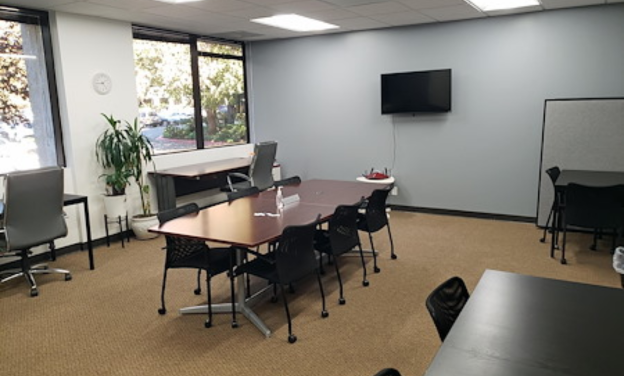
For business owners who want more than just an address and mail handling — who benefit from being around other professionals, getting out of the house on a regular basis, or having a consistent place to do focused work — a coworking space fills that gap without the overhead of a dedicated lease.
Coworking changes the texture of the workday in ways that are difficult to quantify but easy to feel. The separation between home and work is a real psychological benefit for people who spend significant time working from home. Proximity to other professionals in different industries creates the kind of informal networking and cross-pollination that doesn’t happen when you’re working from a kitchen table. The simple act of going somewhere to work — somewhere with reliable internet, professional amenities, and other people who take their work seriously — tends to produce more focused, productive work than the alternative.
The Conejo Valley has a strong and growing community of independent professionals, consultants, entrepreneurs, and remote employees who operate this way — running lean, staying flexible, and using professional space on demand rather than committing to square footage they don’t need full-time. Thousand Oaks in particular sits in a part of Southern California that draws professionals who want proximity to Los Angeles without the cost and density of working in the city. A coworking membership fits that profile well.
Traditional office spaces have a place as well, but the end result is that coworking spaces tend to work better for more smaller businesses
A conventional office lease in the Thousand Oaks area involves base rent, a security deposit that is often two to three months of rent, utilities, internet service, furniture and equipment, cleaning, parking if it isn’t included, and in many cases a multi-year commitment that locks you in regardless of how your business or the broader economy changes. On top of the monthly cost, the time and energy spent managing a physical space — dealing with building issues, coordinating services, maintaining the space — is overhead that competes directly with billable hours or business development.
For most small businesses and solo operators, that level of overhead doesn’t reflect how they actually work. The average independent professional doesn’t need 500 square feet of dedicated office space five days a week. What they need is a professional presence, reliable access to a good workspace when they need it, and the ability to meet clients somewhere that makes a strong impression. A virtual office plan addresses all three without the fixed cost or the long-term commitment.
Plans at OfficeLocale start well below what most professionals spend on a month of coffee shop work sessions, and include the professional address, mail handling, phone answering, and conference room access that cover the situations where a physical presence actually matters. For businesses that occasionally need access to a filming studio for content production, or need digital solutions for day-to-day business operations, those services are available without being locked into fixed monthly overhead.
Not every business model fits this approach equally well. But a wide range of professionals find that a virtual office combined with on-demand workspace access covers everything they need.
It tends to work particularly well for attorneys, therapists, financial advisors, and consultants who see clients occasionally but don’t need a full-time office presence. It works for remote employees who need a reliable place to work away from home without committing to a lease. It works for startups in early stages who need a credible business address before they’re ready to take on the cost of real estate. It works for e-commerce businesses and online service providers who need a commercial address for licensing and shipping purposes. And it works for anyone who has been working from home for years and has started to notice that the lack of a professional address or meeting space is costing them business.
If any of those descriptions fit where you are right now, the math on a virtual office tends to work out clearly in its favor.
The transition from a home address to a professional business address is more straightforward than most people expect. You update your business filings, your website, your email signature, and your client-facing materials. Some businesses choose to do a formal address change with the state. Others simply start using the new address going forward and update things as they come up. Either way, what changes immediately is how your business presents to the outside world.
For many people, that shift has a tangible and fairly quick effect on how prospects and clients engage with them. The questions about legitimacy stop coming up. The hesitation that a residential address was creating disappears. The occasional need for a real meeting space gets handled without scrambling to find a coffee shop with a quiet corner.
OfficeLocale has been providing workspace solutions and business services to professionals in Thousand Oaks and the Conejo Valley since 2002. If you’re ready to take a closer look at what a virtual office plan can do for your business, call 805-777-8866 or reach out through the contact page to discuss which option fits where you are right now.


This is a really insightful post! I especially appreciate the practical tips you’ve shared. I’ve been struggling with remote work productivity, and these suggestions are exactly what I needed.