Remote work solved a real problem. The commute, the overhead, the loss of flexibility — for a lot of professionals and small business owners, getting out of a traditional office made both financial and practical sense. What most people didn’t anticipate was what they’d lose in the process.
The home office is quiet. It’s controlled. But for a number of people, it turns out to be a worse place to work than the office they left — not because of the obvious distractions, but because of subtler things that only become visible once they’re gone.
Human beings are social in a neurobiological sense. The nervous system regulates itself partly through the presence of other people — a process researchers call co-regulation. When the environment includes other calm, present people, the brain’s threat response settles. When it doesn’t, the brain runs at a higher baseline cost, which means more mental effort spent on maintaining focus and less available for the work itself.
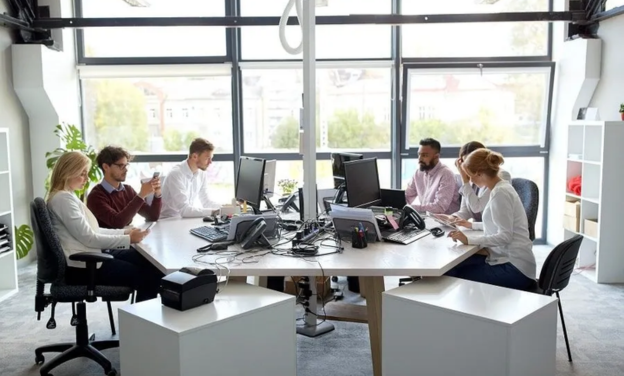
This is the core of what psychologists call ambient belonging — the low-grade sense of being part of something that comes not from specific relationships but from simply being present among others who share a context. It doesn’t require conversation or collaboration. It requires proximity. A room full of people working on their own separate projects produces ambient belonging for everyone in it, even if no one exchanges a word.
The home office provides none of this. The silence that feels productive at first tends to become draining over time. Tasks that would be unremarkable in a populated environment become harder to sustain. The workday loses its natural rhythm, and the psychological cost of working entirely alone — the one that doesn’t show up immediately but accumulates over months — starts to affect both output and wellbeing.
A shared workspace like OfficeLOCALE provides the ambient belonging that the home office lacks. The presence of other working professionals — even strangers — produces the background social signal that the nervous system is built to benefit from. People focus more easily when others are around. Effort feels less costly. The workday has a shape that solitary work doesn’t naturally produce.
Beyond the neurological dimension, shared workspaces provide a set of practical advantages that home offices and coffee shops can’t match:
Working in a shared space doesn’t mean giving up the flexibility that made working from home appealing. It means accessing professional infrastructure when the situation calls for it, without carrying the overhead of a full-time lease.
Research on productivity in different environments consistently finds that the presence of others improves output on tasks requiring sustained focus — a phenomenon called the co-action effect, documented as far back as the 1890s by psychologist Norman Triplett. The effect is real and consistent: people work harder, longer, and with more focus when others are present and working alongside them, even when there’s no interaction, no competition, and no social dynamic of any kind.
The mechanism is the same as ambient belonging — the brain treats the presence of other people as a resource. The perceived cost of effort drops. The threshold for distraction rises. The work simply gets done more efficiently than it would in isolation.
For professionals who struggle with procrastination, difficulty initiating tasks, or the tendency to let the day drift without structure, a shared workspace provides the external conditions that make those challenges easier to manage. The accountability of being in a place where other people are working — even strangers — changes behavior in ways that willpower and to-do lists often don’t.
One of the subtler costs of long-term remote work is what it does to professional identity over time. Work defines a significant part of how most people understand themselves — not only what they do, but where they do it, who they do it alongside, and what that context says about them. A home office in a spare bedroom carries different associations than a professional workspace. Over time, those associations affect how people think about their own work and their own standing.
Working in a shared professional environment reconnects people with the sense of being a working professional in a way that home offices don’t sustain as reliably. The act of going somewhere to work — a specific place, with a specific professional character — reinforces the identity that remote work gradually erodes.
For small business owners and entrepreneurs in particular, maintaining the professional context that a commercial workspace provides keeps the business feeling like a real operation rather than something happening at the kitchen table.
OfficeLOCALE has served professionals and small businesses in the Conejo Valley since 2002, with two locations — in Thousand Oaks and Newbury Park — providing flexible workspace and a full range of business services for members at every level of commitment. From a virtual office membership that provides a professional address and phone presence, to full private office access with conference room availability, OfficeLOCALE’s plans are structured around how professionals actually use a business center rather than requiring more commitment than the situation warrants.
To learn more or schedule a tour of either location, call 805.777.8866 or reach out through the contact page on the website.


This is a really insightful post! I especially appreciate the practical tips you’ve shared. I’ve been struggling with remote work productivity, and these suggestions are exactly what I needed.